
STAR method interview explained: Questions and common mistakes
 Roonan Lingam
16 min read
Roonan Lingam
16 min read

Interviewers may align on the role yet leave interviews with very different interpretations of the same answer. One hears ownership, another hears hesitation. The issue is rarely intent or experience. It is the lack of a shared structure.
The star method interview gives hiring teams a consistent way to ask, listen, and evaluate behavioral responses. By breaking answers into situation, task, action, and result, interviews become easier to probe and compare. For employers, STAR is not about coaching candidates. It is about improving judgment quality, reducing subjectivity, and making hiring decisions more defensible and repeatable.
- The star method interview gives interviewers a shared structure to evaluate behavior consistently, not storytelling ability.
- Strong STAR answers focus on actions and results, with minimal context and clear ownership.
- Behavioral questions work best when they surface real decisions, trade-offs, and outcomes tied to the role.
- Common mistakes include vague ownership, irrelevant examples, and missing measurable results.
- STAR improves fairness, comparison, and confidence in hiring decisions when applied consistently across interviews.
What is the star interview method?
A structured interview without STAR is like reviewing a project without timelines, owners, or outcomes. You hear activity but miss accountability. The star interview method brings order to behavioral interviews by turning stories into comparable signals. It helps interviewers listen for context, ownership, decision-making, and impact in a consistent, repeatable way.
S - Situation
Situation sets the context behind star method interview questions by explaining where and when an event occurred. Strong star method interview answers briefly define constraints, stakeholders, and timing, so interviewers understand the environment before judging decisions. This keeps the star interview technique focused on relevance, not storytelling flair.
T - Task
Task clarifies responsibility within the situation. In star method behavioral interview formats, this step shows what the candidate was accountable for and what success meant. Clear tasks help interviewers compare star interview questions fairly, separating shared context from individual ownership across multiple star method interview answers.
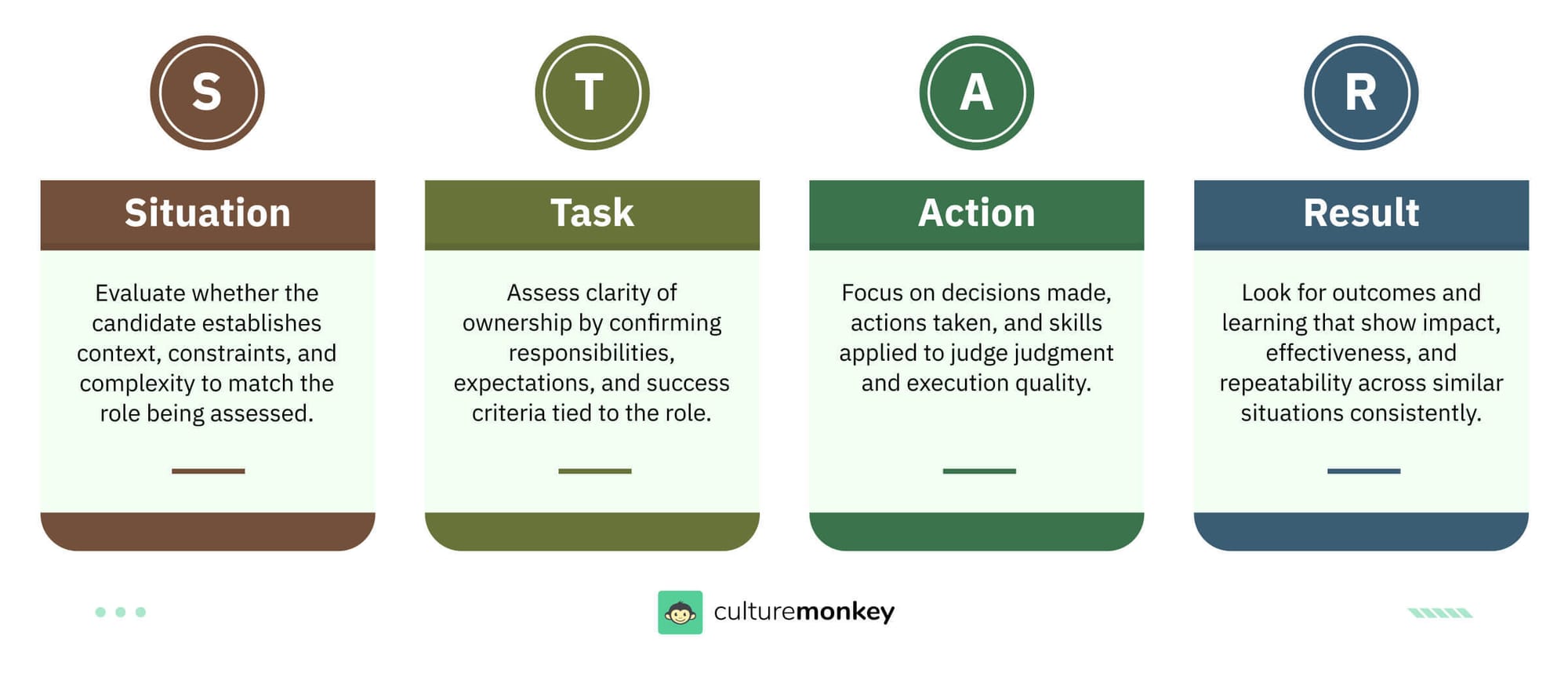
A - Action
Action is the core signal in the STAR interview method evaluations. It explains what the candidate actually did, how choices were made, and which skills were applied. Well-structured star method interview answers here reduce assumptions and help interviewers assess judgment, execution, and problem-solving across star interview technique responses.
R - Result
Result connects effort to impact. Effective star interview questions look for outcomes, learning, or measurable change, not just completion. Clear results in star method interview answers help interviewers judge effectiveness over activity, making comparisons easier when reviewing multiple star method behavioral interview responses side by side.
Star behavioral questions samples

Using the behavioral interview star method is like running a structured review instead of a free-form discussion. Without a shared lens, answers may sound confident but remain hard to compare.
These STAR method interview examples are designed to surface real decisions, actions, and outcomes, helping interviewers evaluate patterns across behavioral interviews, rather than presentation style.
“Describe a situation where you presented complex information.”
This question tests clarity and audience awareness. Strong star method interview answers explain how the message was shaped, how understanding was checked, and how adjustments were made, revealing communication skills beyond surface confidence.
“Share an example of an important personal goal you set.”
This involves surface planning and follow-through. In a star method job interview, listen for how goals were defined, obstacles were handled, and results were achieved, not just statements about motivation or ambition.
“Lead me through a major decision you made.”
This probes structured thinking. Good star answers walk through context, options considered, trade-offs made, and outcomes, making decision quality easier to compare using the star method interview techniques.
“Have you ever handled multiple tasks at once?”
This evaluates prioritization under pressure. Effective star interview technique responses explain sequencing, trade-offs, and risk management, rather than claiming multitasking ability without evidence.
“Give an example of a difficult decision you had to make.”
This reveals judgment under uncertainty. Strong star method interview prep shows how imperfect choices were weighed and owned, not just whether the outcome was positive.
“Tell me about a time you received corrective feedback.”
This test adapts to the user. Look for star method behavioral interview responses that show reflection, behavior change, and learning, rather than defensiveness or justification.
“Describe a challenging technical problem you solved.”
This helps evaluate depth. Clear star method interview examples explain steps taken, assumptions tested, and results achieved, separating real problem-solving from technical jargon.
“Describe your experience working with a team on a project.”
This highlights a collaboration style. Strong behavioral questions here reveal how candidates built trust, handled conflict, and contributed meaningfully within a group.
“Tell me about a time you took the lead on a task.”
This surfaces initiative and ownership. Good star answers explain why leadership was needed, how direction was set, and what impact followed.
Once you have strong behavioral questions, consistency matters more than volume. The star stands as a shared evaluation frame. Next, we break down how to use the star method so interviewers can guide answers, probe deeper, and score responses reliably.
How to use the STAR method for your next interview
Using STAR in a job interview is like giving your management team a clear update: lead with the win, then show how you got there. Done right, the star method helps the interviewer gain insight fast, and weak stories fall away. The steps below show how to use the star method without sounding rehearsed.
- Open with the outcome: Start with the result you achieved, so your star interview feels decisive. Name the positive outcomes first, then backfill context. This creates a positive impression and keeps the listener engaged, instead of waiting for the point.
- Choose one story, not many: Pick a real-life example moment that matches the role, like about a time you handled pushback. Decide just what matters, then stick to it. Specific examples beat claims and prevent your answer from drifting.
- Frame the cast quickly: Mention who was involved and why it mattered, then move on. For example, in a marketing team launch with two team members, state the stakes and constraints. Interviewers need clarity, not a long backstory.
(Source: HBS)
- Go deep on action: Spend most words on what you did, not what others did. Call out key details, trade-offs, and checkpoints. This is where problem-solving shows up, and your problem-solving skills become visible to the interviewer.
- Cut filler and stay crisp: Remove filler words like “sort of” or “maybe,” and use short sentences. Strong communication skills show when you name actions and outcomes plainly. If you ramble, STAR structure collapses under pressure in a job interview.
- Prepare for follow-ups: After your first pass, expect common behavioral interview questions that probe gaps. Practice how you will answer questions on scope, data, and trade-offs. This is how you answer behavioral interview questions without sounding defensive in real time.
- Keep scoring consistently: Treat each response as the behavioral interview star method, even if the question is messy. Use the star as your star technique: reset context, confirm task, detail action, state result. Consistency beats charisma for fair comparisons.
- Rehearse with feedback: Record your star responses, then review for missed numbers and vague claims. A career coach or peer can flag weak spots and improve the interviewer's insight into your thinking. Aim for the same clarity every time.
Use this checklist during star method interview prep, then pressure-test it against role-specific prompts.
When answers stay structured, the star method helps you stay calm and specific. Next, we’ll cover when interviewers expect you to use the STAR method.
When interviewers expect you to use the STAR method

An interview without STAR is like a status meeting with no agenda: everyone talks, but nothing lands. Interviewers expect STAR when they need clean signals, fast, for the job. It helps the interviewer understand what happened, why it mattered, and what you did, especially when roles touch other departments and real constraints.
- Most common interview questions: If you hear “Tell me about a time” or “Walk me through,” assume STAR. These prompts demand answers with clear steps, not opinions. Use the star method to describe actions and outcomes that the interviewer understands quickly.
- Situational questions: When the prompt starts with “What would you do,” interviewers still want STAR-like logic. Provide context, explain your choice, and show how you’d work with other departments daily. This keeps the interview grounded in realistic trade-offs.
(Source: SHRM)
- Conflict resolution: Teams use STAR when tension is at the point. Share a specific example, describe what triggered the conflict, and explain how you de-escalated quickly and calmly. Strong answers show judgment, not drama, and align with company culture expectations.
- Tight deadline: STAR is expected when speed and risk matter. Describe the deadline, what you cut, and what you protected. Explain how you handled stress and communicated status early. A credible story shows delivery without chaos or excuses.
- New services: When a role involves launches, STAR helps prove readiness. Describe how you shipped new services, coordinated dependencies, and managed change. A creative solution only counts if you explain impact, adoption, and what you’d repeat next time.
- Sample questions: If the interviewer shares sample questions or a rubric, that is your cue. Mirror their structure, keep answers consistent, and tie back to the job requirements clearly. This makes scoring easier and reduces “gut feel” decisions.
Mistakes candidates make when using the STAR interview method

Using STAR without discipline is like giving a team update with no metrics, no owner, and no finish line. It sounds busy, but interviewers cannot score it. The star method helps only when each story is tight, role-relevant, and easy to compare across common interview questions. Here are the misses to watch.
- Leading with context: Candidates talk too long before stating the specific situation. Interviewers lose the point. Start with the outcome, then provide context quickly. Keep the story tied to the company and role, not every background detail.
- Blurry ownership: They describe a team win but never clarify their task. Interviewers cannot see skills. State your task in one line, then highlight what you owned. “We did” is fine, but “I did” must be clear.
- Action becomes a list: They talk through steps but skip decisions. STAR is not a checklist. Discuss why you chose one approach, what you dropped, and what you changed. That is where interviewers spot real skills.
- No quantifiable results: They end with “it went well” instead of proof. Add quantifiable results, even simple numbers. If metrics are missing, describe the impact in plain terms. Strong responses always make the point measurable.
- Wrong example for the role: They prepare impressive stories that do not match the job. Use research to pick an example aligned to the role, even if it is a smaller slice of work. Relevance beats drama in the most common behavioral questions.
- Over-rehearsed answers: They sound memorized and dodge follow-ups. Practice structure, not scripts. When interviewers ask potential interview questions, stay calm, answer directly, and adjust the story without losing the star frame.
- Skipping the result: They stop after the action and forget the outcome. STAR needs closure. Tie action to result and learning, then stop. A clean ending helps interviewers compare responses across common behavioral questions.
These mistakes do not mean the candidate is weak. They mean the structure was inconsistent. Next, we will show how Hummer AI helps interviewers spot patterns, compare responses fairly, and flag strengths and gaps across repeated stories.
Using Hummer AI to identify consistent behavioral strengths and gaps
Using Hummer AI is like running a calibration session after every interview, automatically. You do not rely on memory or messy notes. You get the same view across roles, stages, and interviewers, so patterns show up fast. That makes strengths repeatable, gaps visible, and hiring decisions easier to defend.
- Dashboards for pattern visibility: Use the Main Dashboard and Roles Dashboard to spot where interviews stall and where quality drops. Tie candidate progress, time to fill, and recruiter impact to behavioral signals, so strengths and gaps map to outcomes.
- JD to interview plan alignment: Start from the job description, then generate interview plans and scorecards that match required skills. When every panel uses the same criteria, comparisons stay fair, and gaps are easier to diagnose.
- AI interview assistant capture: Let Hummer join as a silent note-taker, then auto-transcribe and summarize. You get clear evidence for what was said, not what was remembered, which reduces bias and improves decision consistency.
- Score highlights and automated scorecards: Use role-specific score highlights and automated scorecards to standardize scoring. Suggested scores and comments create a consistent baseline, while edits let interviewers add nuance without drifting from the rubric.
- TalkTime ratio coaching: Review the TalkTime ratio to catch interviews where candidates spoke too little to show depth. Better balance improves behavioral evidence, helps candidates provide clearer examples, and reduces false negatives caused by interviewer over-talking.
- Ask Cooper for fast validation: Ask Cooper questions like “Where did they show ownership?” or “What evidence supports problem-solving?” It returns interview-backed answers, helping interviewers align quickly and avoid opinion-led debates.
- Sentiment and engagement signals: Use sentiment trends to flag interviews that felt “off” and investigate why. It is not a hiring decision by itself, but it is a useful cue to revisit key moments and tighten your process.
Conclusion
The star method interview has become a workplace standard because it turns conversations into evidence. In modern hiring, organisations cannot rely on intuition, memory, or storytelling flair alone. STAR creates a shared language for interviewers to assess behavior, decision-making, and impact consistently. Key takeaways include improved fairness, reduced bias, and hiring decisions that are easier to explain, defend, and repeat at scale.
However, STAR only works when it is applied consistently across roles, panels, and time. That is where Hummer AI plays a critical role. Hummer AI captures interviews automatically, structures STAR-aligned signals, and turns individual responses into comparable data. Practical tips include using interview summaries, automated scorecards, TalkTime ratios, and Ask Cooper validations to maintain alignment without adding manual effort.
Together, the star method interview and Hummer AI help organisations move from subjective impressions to structured hiring intelligence, enabling better decisions, faster alignment, and stronger confidence in every hire.
FAQs
1. What is the STAR interview method, and why do interviewers use it?
The STAR interview method structures behavioral answers into situation, task, action, and result. Interviewers use it to compare candidates consistently, reduce bias, and focus on evidence, not storytelling. STAR makes it easier to probe decision-making, ownership, and impact across the same questions. It also improves panel alignment because everyone scores the same signals, not impressions.
2. How do I answer behavioral interview questions using the STAR method?
To answer behavioral interview questions with STAR, pick one relevant example and state the situation in one line. Define your task so ownership is clear. Spend most time on the actions you personally took, including choices and trade-offs. Close with the result and what changed. Keep it tight, then pause so interviewers can ask follow-ups.
3. Can you give an example of a strong STAR method interview answer?
A strong STAR answer sounds like: “Situation: Our launch slipped. Task: I owned recovery. Action: I reprioritized work, reset timelines, and aligned stakeholders with daily checkpoints. Result: We shipped two weeks earlier than the revised plan and reduced rework.” Interviewers like it because it’s specific, shows decisions, and links actions to measurable outcomes for hiring.
4. What are common mistakes candidates make with the STAR method?
Common mistakes include over-explaining the situation, hiding behind “we” so the task is unclear, and listing actions without explaining why. Many candidates skip the result or give vague wins like “it went well.” Others use irrelevant stories that don’t match the role. These issues make answers hard to score and force interviewers to guess quickly.
5. How long should a STAR method interview answer be?
Most STAR answers should take about 60 to 120 seconds. That is long enough to cover key context, your actions, and results, while leaving room for probing questions. If you go longer, interviewers lose the thread and miss the point. If you go shorter, the evidence feels thin. Aim for clarity, then stop and invite follow-up.
6. Is the STAR method good for all types of job interviews?
STAR is best for behavioral interviews and situational questions where interviewers want proof of how you act at work. It is less important in pure technical screens, case interviews, or portfolio reviews, where artifacts and problem-solving matter most. Still, STAR helps you explain decisions and outcomes clearly, so it often improves any job interview response that involves experience.
7. How do recruiters evaluate STAR method interview answers?
Recruiters evaluate STAR answers for relevance to the job, clarity of ownership, quality of actions, and strength of results. They look for repeat patterns across responses, not one-off hero stories. Strong answers include key details, trade-offs, and measurable impact. Clear structure also helps panels compare candidates fairly and document feedback consistently for hiring decisions today.
8. Are there better methods than STAR for answering interview questions?
Some candidates use CAR, SOAR, or PAR, but STAR remains the most familiar to interviewers. The “best” method is the one that makes your evidence easy to follow and score. STAR works because it separates context from action and impact. If you prefer another framework, keep the same logic and don’t confuse the interviewer with new labels.
More from HummerAI Blog

Recruitment dashboard guide: what to track and why it matters
A recruitment dashboard is a centralized view of hiring activity that shows role status, candidate progress, bottlenecks, and key metrics, helping teams track what’s moving, what’s stalled, and where decisions are needed across the hiring process.
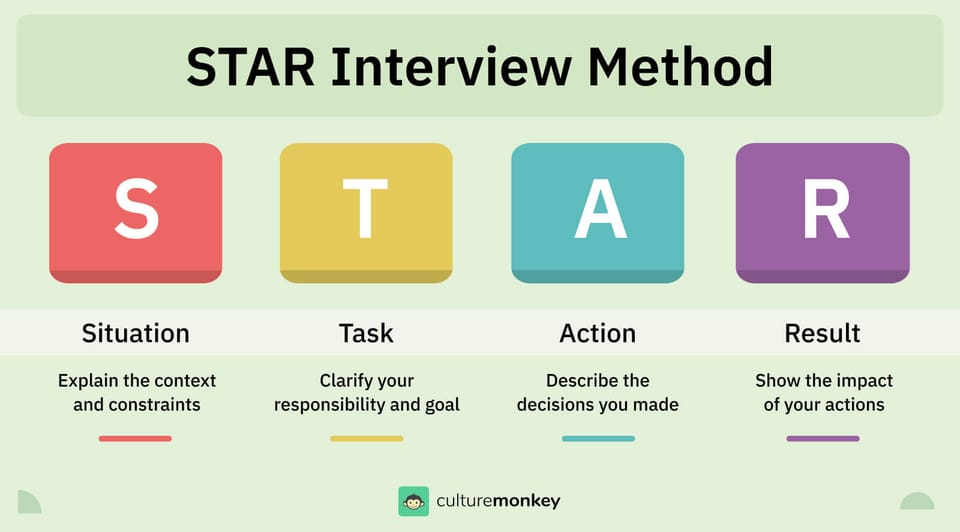
STAR method interview questions: How to answer them with real examples
STAR method interview questions are structured prompts that ask candidates to explain a situation, action, and result to assess real past behavior clearly.